






Former Congressman Clement Visits Columbia State Class for History Lecture
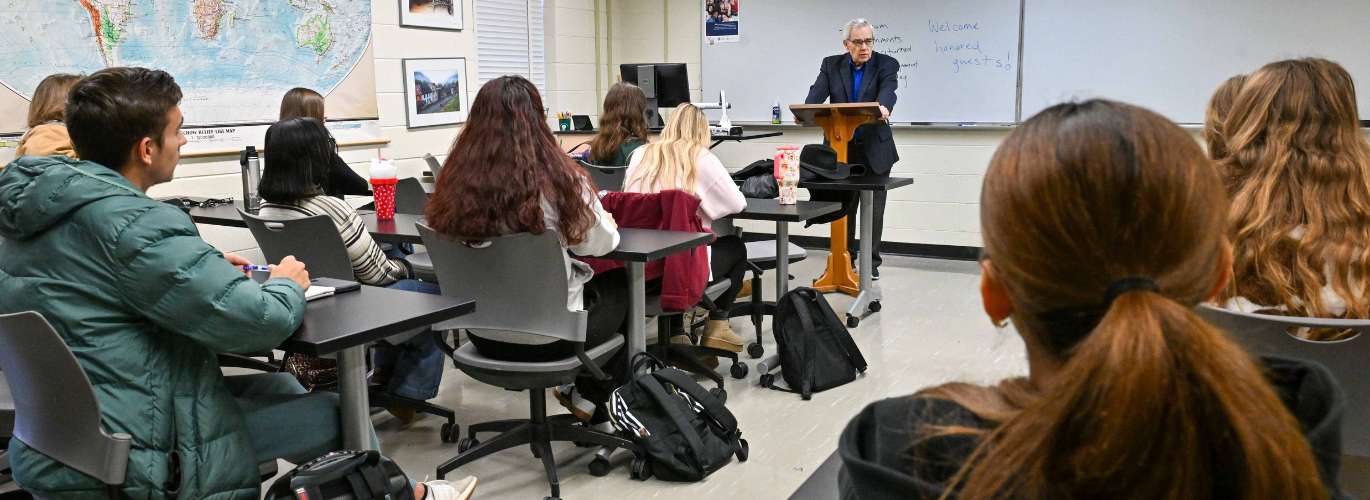
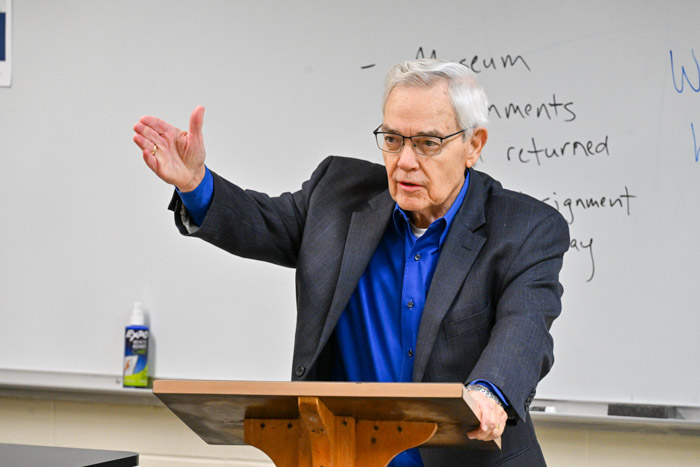
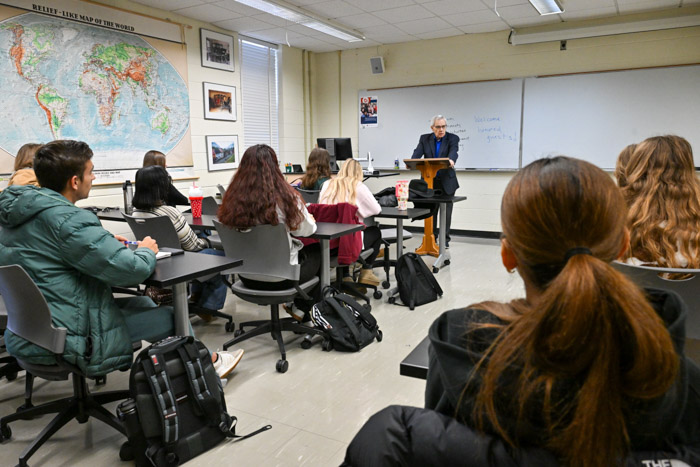
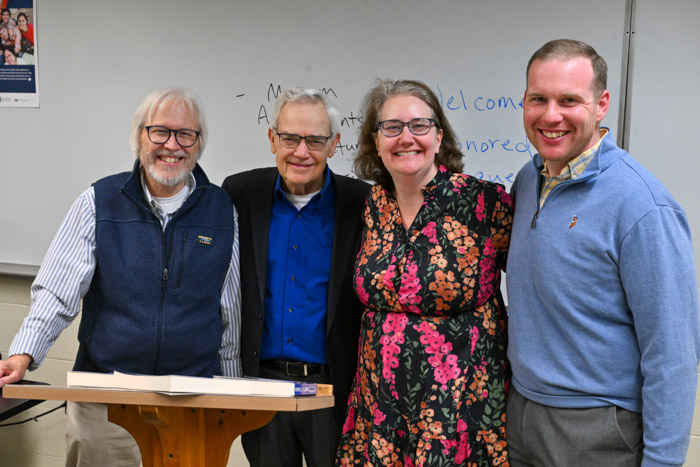
Former U.S. Representative from Tennessee Robert “Bob” Clement and Zacharie Kinslow, executive director of the Clement Railroad Hotel Museum, recently spoke to a Columbia State history class about the legacy of former Governor Frank Clement and his impact on community colleges in the state.
Kinslow, a former Columbia State adjunct instructor of history and a Columbia State alum, began the talk by summarizing how Frank Clement, the 41st governor of Tennessee, moved the once primarily agriculture-driven economy of the state to one driven by industry and manufacturing. With the changing landscape, Clement also believed the state needed to expand access to higher education offerings, especially for adults already in the workforce. This led to him reaching out to then-Education Commissioner J. Howard Warf, who helped to create Tennessee’s community college system, began with Columbia State in 1966.
Both Clement and Warf became the namesake for two buildings on Columbia State’s campus.
During his time in office, Clement also became the first governor in the South to veto a segregation bill, as well as overseeing the integration of public schools statewide, beginning with Clinton High School.
After seeing the need for better access to educational materials in his hometown of Dickson, Clement moved to give free access to textbooks for all K-12 public school students in Tennessee.
Bob Clement spoke about his memories and legacy that his father, Frank Clement, who, after first being elected to the governor’s office at 32 years old and serving 10 years, was a driven man. Bob Clement said that drive and determination toward a goal in life are also something students should strive for.
“At age 16, can you imagine, he'd tell his friends, ‘I'm going to be governor of Tennessee one day’,” Clement said. “I'm sure some of them laughed. ‘Sure, that's not going to happen,’ but he would say that on a regular, continuing basis. And everything he said and did from the time he was age 16, toward that one objective, at 32, was toward that goal. And at age 32, he was elected governor of Tennessee, and that's why I challenge all of you in this room, if you can, to make a decision on what you want to do in your life. Ask, ‘What difference do I want to make in my life?’ And the better off you will be.”
Clement, who served 15 years in Congress and held roles in the Tennessee Army National Guard and as president of Cumberland University, also offered personal advice for students who are still uncertain about their career paths.
“I know for myself, I've had seven career changes in my life,” he said.” Now, I'm not talking about job changes, I'm talking about career changes, and you're going to have that happen to you as well, but I accepted it as a challenge. I learned a lot of new things.”
When asked by a student how it feels when people speak about his life’s work while he’s in the room, Clement expressed gratitude for his career and what his philosophy on life is.
“I've accomplished a lot, thank God, and been blessed,” he said. “And I keep moving forward. But I've had it at times, real tough, too. Honestly, I think you learn more through adversity than you do through success. But when it's going along, you think you've done everything right, when you do something wrong, you sometimes think everything you've done is wrong, which is not correct either. But I do think you have to take chances at times in life to get ahead, and sometimes it works out, and sometimes it doesn’t.”
“We are grateful to Congressman Clement for sharing his life story with my Tennessee History class,” said Emily Senefeld, Columbia State instructor of history. “He truly embodies the connection between the past we have studied and the present day. With Columbia State celebrating its 60th anniversary, it is also a fitting time to reflect on Governor Frank Clement's legacy in establishing Tennessee's first community college.”
“Congressman Clement is a great friend to Columbia State and to everyone in the state of Tennessee,” said Dr. Barry Gidcomb, Columbia State dean of the Humanities and Social Sciences Division and professor of history. “Like his father, he has dedicated his life to public service and making the lives of all Tennesseans better.”
For more information on Columbia State’s history and political science programs, please visit our website www.ColumbiaState.edu/academics/humanities-and-social-sciences.